A meeting sparked a mission.
In 1998, Ike Keener, then CEO of what is now Allegacy Financial, gathered members of his management team in a conference room at the credit union's Winston-Salem headquarters. Three employees had been diagnosed with breast cancer, and a friend of Keener's had recently died from ovarian cancer.
He posed a question: What could the organization do about it?
“There was a lack of resources and early testing wasn’t available to everyone. We realized there were a lot of folks who didn’t have access to the kind of benefits we had at that time,” said Ken Elkins, senior vice president of consumer lending, who was in the room that day. “Ike was an idea guy. He asked, ‘You think we could pull this off? You think we could do this and maybe raise some money?'"
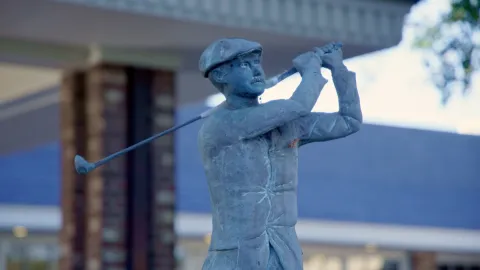
For 27 years, the answer to Keener's question has been the Don't Wait Golf Tournament, which will be held on Oct. 1 this year.
What began as colleagues looking for a way to help their own team members has grown into a commitment that spans nearly three decades.
The tournament was created to promote early cancer awareness and detection and has raised more than $1.5 million for Cancer Services, a Winston-Salem nonprofit that provides direct client assistance, medical supplies, transportation to treatment, education and support resources for breast and ovarian cancer patients across the region.
Don't Wait: A mission rooted in every generation
Allegacy Financial is a member-owned credit union rooted in North Carolina since 1967, serving members with personal, small business, commercial, and wealth management solutions
For Allegacy team members, the commitment behind Don't Wait has been carried from one generation of colleagues to the next. Talk to those who help bring the tournament to life, and chances are you’ll hear a personal story about cancer.
Lori Timm, director of community impact, first learned about Don’t Wait during new-hire orientation when she joined Allegacy in 2007.
"We heard the story of the women who were impacted by cancer diagnoses," Timm said. "That was very much a part of our onboarding as new employees ... and that was impactful to me."
Luke Walker, program manager for sports sponsorships and marquee events at Allegacy, has his own connection: his stepmother was diagnosed with breast cancer about a year and a half ago and is now in remission.
“Being impacted by cancer — whether it’s family, friends or even yourself — is such a common experience. It’s easy to get behind it because everyone can personally relate to the cause,” he said.
At the tournament, behind every tee box are Allegacy team member volunteers who have spent years refining every detail — from hauling coolers in horse trailers to coordinating two full courses at once. Hole-in-one prizes, a popular silent auction, and other traditions are a draw, but team members say the purpose behind the day is what keeps golfers coming back.
A shared commitment to cancer care: ‘We’re all touched by this’
Golf's emergence as the way to raise funds still surprises some of the people who were there at the beginning. When Keener started the initiative at Allegacy Financial, then known as Reynolds Carolina Credit Union, he wasn't even a golfer, and few others in the C-suite played competitively.
One executive lived along Salem Glen Country Club in Clemmons, so the course became the tournament's first home. The event quickly outgrew the venue and was moved to the private Bermuda Run Country Club, whose two courses better accommodate the more than 200 golfers who participate each year.
But it’s the relationship with Cancer Services that has been integral to the tournament’s success, according to Donna Hennessey, Allegacy's director of private banking, who has been involved since 2001 and helped build the partnership from the ground up.
Since the tournament’s launch, Cancer Services has used the funding to help almost 1,500 breast and ovarian cancer survivors through medical and financial assistance, patient advocacy and wellness programs. That support can take many forms, from cooking classes taught by a cancer dietician to a volunteer mowing a patient's yard during chemotherapy treatments.
“We're all touched by this,” Hennessey said. “That's why it's so important. Cancer Services’ reach is amazing and their services are free, so we're trying to spread the word that there are people who can help you."
Charlie Ross, Cancer Services’ marketing and development director, has seen that need up close. Working from temporary office space near the front door of the organization's operations center, he has watched a steady stream of people walk in looking for services — or asking how they can help.
For Ross, relationships with organizations like Allegacy help more people in the community learn that support is available.
"It's another one of those things that ties the community back together and lets people know — people who might not have known already — that there are resources available here," Ross added. "You don't think about this kind of service until you either have a diagnosis of cancer yourself or a loved one gets that diagnosis. Your world gets kind of flipped upside down."
“Alive, beautiful, and victorious”
Allegacy Financial President and CEO Nathanael Tarwasokono sees Don’t Wait as an example of what long-standing relationships can make possible.
“This tournament has always been about people showing up for people,” Tarwasokono said. “What began with team members wanting to help others facing cancer has grown into a lasting relationship with Cancer Services and our community — and a powerful example of what can happen when we come together around something that matters.”
That commitment has a physical presence outside Allegacy’s Winston-Salem headquarters.
The Ponds of Hope and The Park grew from Keener’s vision for turning a required runoff area into something meaningful for the community: a tranquil place dedicated to breast and ovarian cancer awareness and open to those whose lives have been touched by the diseases.
A sculpture by Earline Heath King, titled “Alive, Beautiful, and Victorious,” stands at the heart of The Park, featuring three bronze figures modeled after local cancer survivors Caroline Ebeid, Deborah Howard and Pam Versaggi.
With $1.5 million raised and counting, the tournament has far outgrown the modest goal Elkins remembers from that first year.
"We thought if we came up with $5,000 or $6,000, we would be doing pretty darn good," he said.
Now he imagines that same spirit reaching more communities across North Carolina, including Asheville, Charlotte, Greensboro and beyond. For Elkins, the possibility of carrying the effort into more communities matters more than simply growing the tournament itself.
"This isn't about producing a number. This is about the people,” he said.
For Hennessey, the payoff is just as personal.
“It’s so uplifting, because we feel like we're truly making a difference," she said. "What we're doing matters."
Join the effort to support local cancer patients
You can support Cancer Services year-round by making a donation.